


On this page
Introduction — Why Prevention Now
Set the case for transition to preventive dental practice in India: rising chronic disease burden, cost sensitivity, and patient demand for convenience; define prevention vs treatment dentistry and the upside for outcomes and margins.
Understanding Patients — Behaviour & Beliefs
Map patient behaviour in dental care: triggers, barriers, and trust factors shaping the dentist-patient relationship India. Use surveys and chairside interviews to tailor dental health education and engagement.

The Proactive Care Model
Design a proactive dental treatment model: risk assessment (caries/perio), recall stratification, fluoride/sealants/desensitizers, nutrition coaching, and home protocols—foundations of preventive dentistry India.
Education, Habits & Home Care
Operationalise oral hygiene awareness India with bite-sized content, visual biofilm disclosure, and habit loops. Drive habit change in dental patients using reminders, trackable goals, and simple preventive dental care tips (brush/technique, interdental aids, fluoride, diet timing).
Systems & Services That Make Prevention Stick
Embed prevention in workflows: pre-visit triage, chairside risk dashboards, hygienist-led recalls, and preventive bundles. Align pricing, membership plans, and communications to normalize prevention vs treatment dentistry within dentist-patient relationship India.
Conclusion — Roadmap to a Preventive Practice
A practical plan for transition to preventive dental practice: audit risk mix → train team on scripts/tools → launch prevention bundles → measure adherence, disease reduction, and visit cadence. Tie KPIs to recalls, NPS, and reduced emergencies to scale preventive dentistry India sustainably.
Introduction — Why Prevention Now
Across India, lifestyle-linked dental disease is no longer random — it’s predictable. With rising diabetes, hypertension, stress, and frequent snacking, we are seeing a steady increase in caries and periodontal issues across all age groups. Patients today live fast, eat fast, and postpone care until something hurts. In this environment, a preventive model is not just a noble idea; it is the only approach that actually fits modern behaviour, modern expectations, and modern disease patterns. Patients don’t want repeated emergencies, surprise expenses, or long, painful chair sessions. They want clarity, predictability, comfort, and control. Prevention delivers exactly that.
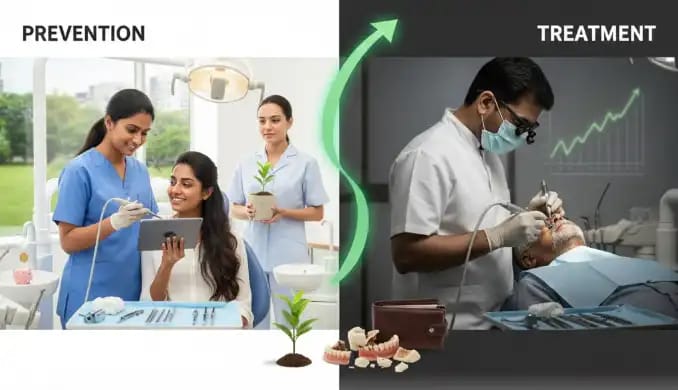
When we differentiate treatment-based care from prevention-led care, the contrast is clear. A treatment-only clinic waits for breakdowns and reacts. A prevention-focused clinic identifies risk early, controls it, educates simply, and schedules maintenance before disease escalates. The result is healthier patients, smoother schedules, and far fewer stressful clinical surprises. Even financially, prevention stabilises cash flow through predictable recall visits, bundling opportunities, and steady hygiene-based acceptance, instead of depending only on occasional high-value cases.
In India, the biggest lever for prevention isn’t technology — it’s behaviour. With simple tools like biofilm disclosure, short chairside coaching, WhatsApp nudges, and easy-to-follow maintenance plans, clinics can guide patients from crisis-based decision-making to proactive oral health habits. Over this series, we’ll walk through the building blocks — risk scoring, communication, habit loops, and recall systems — to help you establish a preventive model that protects patient health while strengthening your operations and P&L. Prevention, done right, creates calmer clinics, happier patients, and healthier outcomes.
Understanding Patients — Behaviour & Beliefs
If we want patients to embrace preventive care, we must first understand what shapes their decisions. In India, dental choices are emotional before they are clinical. People act when something hurts, when an event is coming up, or when someone they trust tells them to. Pain, upcoming weddings, employer check-ups, cosmetic goals, and family referrals are common triggers that bring patients to the chair. But just as important are the barriers that hold them back — fear of pain, unclear costs, embarrassment about oral condition, lack of time, past negative experiences, and the belief that “if it doesn’t hurt, it’s not urgent.”
Trust is the real currency in prevention. Patients feel confident when they see transparent pricing, bilingual explanations, clear visuals like intraoral photos or scans, visible sterilization, on-time appointments, and structured follow-up on WhatsApp. These behaviours signal that the clinic is organised, respectful, and patient-centric — which lowers resistance and increases acceptance.
To personalise your approach, use a short 2-minute intake survey and a quick chairside conversation. Ask questions like, “What is your biggest worry?” or “What would make today a 10/10 experience for you?” These micro-insights help you tailor education and recommendations. For a fearful patient, comfort and visuals matter most. For a cost-sensitive patient, simplified Good–Better–Best options build trust. For time-pressed individuals, fast routines and weekend recalls help them stay consistent.
Finally, segment your patients: prevention-friendly, pain-driven, or aesthetic-focused. Adjust scripts, follow-ups, and reminders for each group. When communication becomes personalised, prevention acceptance rises naturally — not through pressure, but through clarity, empathy, and trust.
The Proactive Care Model
A preventive practice needs a repeatable system — not random advice. A proactive care model has three goals: identify risk early, reduce it consistently, and monitor it over time. The process starts with a structured 5–7 minute risk assessment. For caries, review diet frequency, saliva quality, white-spot activity, and past history. For perio, track plaque scores, bleeding points, pocket depths, and health factors like smoking or diabetes. Summarise it into a simple Low / Moderate / High risk score with one clear reason. Patients remember simplicity — not long explanations.
Next, structure recall intervals by risk instead of using the same 6-month template for everyone. Low-risk patients can return every 6–12 months, moderate-risk every 4–6 months, and high-risk patients every 8–12 weeks initially. This approach feels scientific, personal, and credible.
During professional visits, build a standard prevention bundle: biofilm disclosure, fluoride, sealants where needed, photos to track change, and targeted antimicrobial steps for perio-risk patients. Then add a two-minute nutrition and habit coaching step — small advice, not lectures. The final layer is personalised home-care plans. Keep it crisp: Low risk = basics done well; Moderate/High risk = upgraded home protocol with high-fluoride paste, salivary support, or CHX when appropriate.
Use automation to stay on track — WhatsApp reminders, saved home-care videos, and 30-day check-ins for high-risk cases. Track a few KPIs: bleeding %, new caries, no-show rates, and follow-through. When the system is consistent, prevention becomes predictable — for you and for your patients.
Education, Habits & Home Care
Most patients don’t lack awareness — they lack clarity, simplicity, and follow-through. That’s why effective preventive care relies on showing, not lecturing. Start with visuals. A quick biofilm disclosure and a photo of missed areas creates instant awareness. Then, instead of verbally explaining brushing angles, record a 20-second video on the patient’s own phone demonstrating their corrected technique. People rewatch what they own.
Next, focus on habit loops, not willpower. Build a cue–routine–reward model:
Cue — toothbrush kept near a morning trigger (like kettle or phone charger)
Routine — 2-minute brush + 1-minute interdental
Reward — streak tracking, praise at recall, or a simple progress check
Patients respond to goals like “zero bleeding sites” or “14-day streak” far better than generic advice.
Then offer practical, bite-sized instructions: soft brush, gentle circles, pea-sized fluoride paste, spit-don’t-rinse, interdental once daily, tongue last, sweets with meals (not between), rinse after acids, hydrate, and xylitol for frequent snackers. For sensitivity, one-minute nighttime desensitizing paste works wonders. For high-risk or diabetic patients, shorter recalls and clearer accountability help keep disease in check.
Finally, support behaviour outside the clinic. Send an AM/PM routine card, their personal technique video, and one weekly WhatsApp nudge for those at higher risk. At recalls, re-disclose, re-photo, and celebrate improvement. Small routines layered over time create real change. When patients feel progress — not guilt — prevention becomes a habit, not a burden.
Systems & Services That Make Prevention Stick
Prevention succeeds only when it becomes part of your clinic’s operating system — not an optional add-on that depends on memory or mood. Start with pre-visit triage on WhatsApp or SMS. A short form that asks about diet, bleeding, medical factors, and last dental visit allows you to preload risk notes and come prepared before the patient even sits down.
Next, use chairside dashboards — a simple, colour-coded sheet with risk scores, bleeding %, photos, and recall plan. This makes conversations faster and more credible. Then, make hygiene and prevention a dedicated service block, not something squeezed between restorative work. Hygienist- or assistant-led recall appointments create rhythm and free the dentist for complex procedures.
Package prevention into clear service bundles — for example:
Clean+Protect for low-risk
PerioCare for moderate/high risk
KidsShield for children
When bundles are named, priced, explained with visuals, and paired with a take-home plan, acceptance rises dramatically. To go one step further, offer membership plans — two hygiene visits, fluoride, tele-check support, and special rates on emergencies. This shifts patient psychology from “I’ll come when there’s pain” to “I’m enrolled in staying healthy.”
Communication keeps prevention running. Use bilingual scripts, consistent recall reminders, and progress photos. Track recall adherence, bleeding %, new lesions, and NPS monthly. Review, refine, repeat. When prevention is scheduled, priced, communicated, measured, and celebrated, it becomes the default behaviour of your clinic — and that is when the model truly sticks.
Conclusion — Roadmap to a Preventive Practice
A preventive practice isn’t built through motivation — it is built through structure. The roadmap is simple and realistic.
Weeks 1–2: Audit your last 6–12 months. Identify emergencies, recall gaps, risk patterns, and no-show causes.
Weeks 3–4: Train your team using one-page scripts, visuals, and bilingual explanations. Rehearse how to show risk, explain photos, and guide home care without sounding pushy.
Week 5: Launch three prevention bundles with clear recall plans.
Weeks 6–8: Implement chairside dashboards, hygienist-led recalls, and automated reminders.
Monthly: Review KPIs — recall adherence, bleeding %, new lesions, emergencies, acceptance, and NPS.
Quarterly: Improve scripts, adjust pricing, and celebrate patient progress.
When prevention becomes part of your workflow and language, everything gets easier — schedules stabilise, trust increases, chairside stress drops, and more patients say “yes” earlier in the disease cycle. You spend less time firefighting and more time delivering high-quality dentistry — the part you actually love.
India is ready for preventive dentistry — patients want predictable costs, fewer emergencies, and better control over their oral health. Clinics that master prevention will build deeper loyalty, stronger reputation, and healthier margins. Start small, stay consistent, and refine continuously. A proactive dental practice isn’t just good for your patients — it’s good for your peace of mind, your team, and your long-term growth.
Related Products
Disclaimer
This article is for general information. Product specifications and features change with the manufacturer — confirm details with our team before you buy. Full disclaimer