
On this page
The Invisible Physics Inside Your Handpiece.
We’ve all faced the situation where we apply pressure to our bur and the bur just refuses to cut through dense enamel or suddenly lose that wonderful tactile feedback right above the pulp chamber during excavation. The reality is that all of these day-to-day frustrations stem not from a deficiency in technique, but from working against the physics of our equipment.
A gear ratio is simply the mechanical ratio of a handpiece and the fundamental reason why there is no such thing as a ‘universal’ handpiece. By adjusting the gears within a motor, we can optimize for increased torque (cutting power) or high speed (for cutting hard tissues such as enamel) – once you understand how to match a gear ratio to a tissue, your clinical life with handpieces is transformed.
The 1:1 Direct Drive: Your Foundation Tactile Control.
The 1:1 ratio provides a direct connection between the motor and the bur (There is no increase in speed, making the bur spin at the direct speed of the micromotor ).
Due to the absence of gearing and its direct connection to the motor, the 1:1 ratio provides a tactile ‘grab’ of the dentin that is essential for conservative caries excavations, fine finishing and polishing of composite restorations. The use of high-speed turbines for these indications completely eliminates the tactile feedback and increases the risk of pulpal exposure
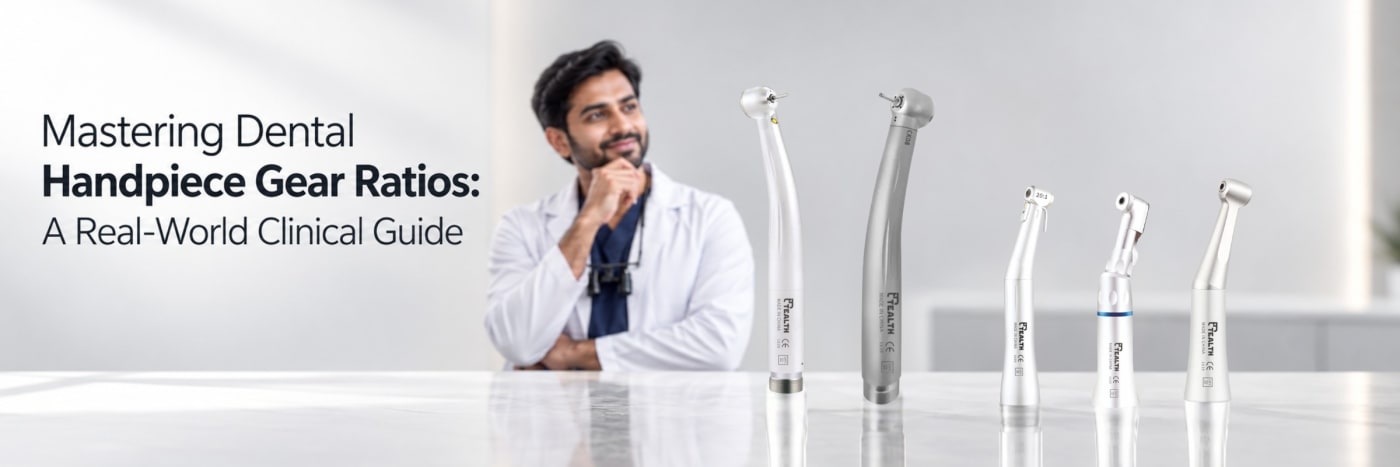
For all of your ‘restorative’ days in the operatory, the Tealth 1:1 External Irrigation Push Button Contra Angle Handpiece is a fantastic workhorse. The push-button chuck allows for rapid bur changes and the external irrigation maintains the tooth’s integrity. A latch-type handpiece is a great value if you are outfitting a dental school or need an incredibly durable contra angle for prophylaxis.
The 20:1 Reduction: Bone Safety and Maximum Torque.
When switching to the realm of oral surgery and dental implants, speed is actually detrimental to your ability to seat an implant safely. The friction created by drilling into dense cortical bone at high speeds causes the temperature of the bone to rise, potentially killing off cells and creating a non-integrable region around the implant site (this occurs at temperatures of >47 oC).
The 20:1 ratio prevents this by reducing the motor speed by a factor of 20 , thereby reducing bone heating while creating massive amounts of torque necessary to cut through dense cortical bone.
You will need a handpiece that has high torque and is less likely to lock-up during an osteotomy. The Tealth 20:1 LED Implant Contra Angle Handpiece is specifically designed for implant surgery, providing massive amounts of torque (80 N.cm) required to cut through dense Type I bone. The self-generated LED can be used to illuminate deep recesses and the internal/external irrigation ensures optimal cooling of the bone during surgery.
Aerodynamics: Why You Need “Super Torque” For Gross Reduction ?
For removing crowns made of zirconia or removing old amalgam restorations, you need speed to perform the gross reduction. While electric motors use 1:5 increasing gears to achieve the necessary speed, many of us are still using traditional air-driven ‘high-speeds’.
While air-turbines use compressed air to create speed (many in excess of 300,000 RPMs), they have no internal gears and can ‘stall’ easily when placed under the lateral pressure of a bur trying to cut dense enamel or porcelain.
The solution to this is a special type of head called a “Super Torque”, which utilizes a larger and heavier turbine rotor that maintains momentum when placed under load.
If you’re looking for reliable speed for crown preparations, the Tealth Super Torque Head LED Push Button Airotor will reduce your crown preps to a momentary annoyance. Stall-proof and loaded with a powerful light source to eliminate posterior quadrant shadows, the non-LED Tealth Super Torque Airotor is an incredibly durable and cost-effective alternative to LED heads.
Smart Workflow: Matching the Tool to the Tissue
To maximize your efficiency and reduce the strain on your high-speed bearings, you need to use the right tool for the right job. Enamel Reduction & Crown Preps: Let the aerodynamics do the work. Tealth Super Torque Airotors .
Dentin Excavation & Polishing: Switch to light-duty contra angles to reduce lateral stress on your high-speed bearings while still maintaining tactile feedback for conservative removal of caries and polishing. The Tealth 1:1 External Irrigation Push Button Contra Angle Handpieces or the latch-type are excellent workhorses for this.
Implant Placement: Avoid burning your patient’s bone by using a handpiece that utilizes a 20:1 gear reduction. The Tealth 20:1 LED Implant Handpiece has enough torque to get the job done while avoiding excessive bone heating.
Stop Fighting Your Equipment
A thorough understanding of the physics of your handpiece allows you to stop fighting your equipment. By choosing the correct mechanical advantage, you reduce hand fatigue, reduce wear on your gear-reduction systems and improve your overall enjoyment of dentistry
You’ll be surprised how far a good understanding of the principles of mechanics can take you without shelling out a fortune. To upgrade your practice’s arsenal of handpieces with the necessary mechanical advantage, you can purchase an entire line of authentic Tealth handpieces from Unicorn DenMart Ltd (as they are the official supplier of modern practices, ensuring the necessary tools are available to provide the care you demand).
Related Products
 Asiga Max 3D Printer
 Asiga Max 2 Printer
 Asiga The Ultra 3D Printer
 Shining 3D AccuFab-L4K 3D Printer
 Phrozen Mighty 4K 3D Printer
 Elegoo Saturn 3 3D Printer
 GLB 200M Metal 3D Printer
 GLB 120M Metal 3D Printer
Disclaimer
This article is for general information. Product specifications and features change with the manufacturer — confirm details with our team before you buy. Full disclaimer