
On this page
The Wall Mounted X-Ray: A Changing Paradigm
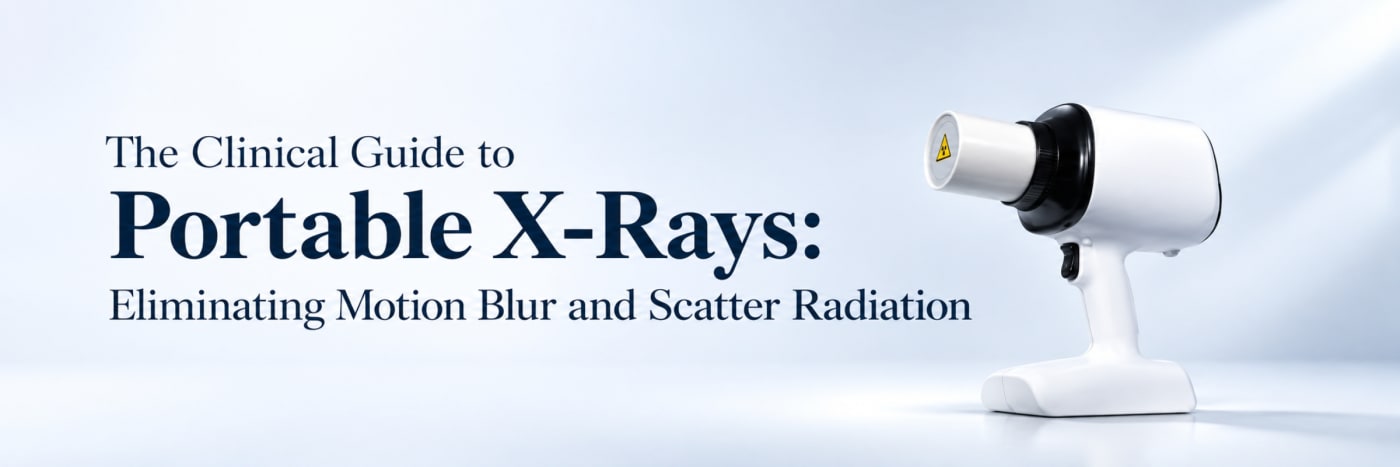
Wall mounted X-rays have long been the pillar of any successful dental practice. However, as practices grow from single chair to multiple, the need to keep a patient tethered to one room becomes unwieldy. The move towards handheld/detachable units has its own share of issues.Many early and budget friendly units suffer from imbalanced weight, poor power delivery and shielding, leading to operator fatigue, a high rate of motion blur retakes, and concerns about scatter radiation.Today, to upgrade a practice’s imaging chain is to embrace high frequency DC technology: a technology that prioritizes the operator’s time and safety, while capturing a diagnostic image right on click. This is why the elite practices across the world are standardizing their operating procedures around the Runyes Ray 98P Portable X-Ray.Capturing the Margins: Focal Spot Size Revealed
Nothing is more frustrating for a busy practitioner than to mount the imaging sensor, capture an RVG, and discover that the margins are hazy, or the lamina dura indistinct. In many cases, operators will blame their sensor; however, the true reason often lies in the unit’s focal spot size.In radiographic physics, larger focal spot = larger “penumbra” or blurriness around the image. To capture a high fidelity diagnostic image, one must prioritize a machine with a minimal spot size. The Runyes Ray 98P takes advantage of a focused 0.4mm spot (Thanks to its premium Canon tube), reducing the penumbra and guaranteeing a high quality image on every patient on your first try. Whether it’s an endodontic file length check or periodontal examination, you’ll see clearly on your first click.Operator Safety: What to do About Scatter Radiation?
The number one concern professionals have when buying x-ray equipment, is operator exposure. Hand held units present a unique challenge compared to their wall mounted counterparts, since you are inches away from the scatter source.When you take an image with a handheld unit, you expose yourself to radiation bouncing back at you from the patient’s tissues. To combat this dangerous exposure, the best portable x-ray units on the market will have reinforced internal shielding to block scatter radiation from exiting the machine, as well as a rear external shield to block direct exposure.Runyes Ray 98P addresses operator safety by implementing a dual lead internal shielding design, blocking internal scatter radiation and limiting operator exposure, staying well within the permissible international limits of exposure during everyday use.Motion Artifact and Operator Fatigue Explained

AC Current vs DC Current: Why it Matters
Traditional AC (Alternating Current) X-ray units have long been the standard for cost effective imaging.However, this comes at the price of greater patient exposure. Alternating current produces a pulsed wave of radiation, which loses energy during the pulse, meaning there is a higher percentage of “wasted” radiation that fails to penetrate the patient’s body and is absorbed instead Modern operators have switched to DC (Direct Current) high frequency technology, a superior power supply that utilizes a constant current to achieve greater penetration with less patient exposure. The Runyes Ray 98P provides a consistent 70kV high frequency DC output, guaranteeing minimal patient exposure on every shot, without compromising your ability to capture a diagnostic image. Combined with a high capacity lithium battery, the Ray can provide hundreds of shots on a single charge, without interrupting your day to recharge the unit. This makes the Ray compatible with all modern RVG sensors and phosphor plate systems, without disrupting your busy workflow.Securing Your Diagnostic Toolkit
The move toward a high end portable X-ray is a huge step towards eliminating workflow roadblocks, reducing patient exposure for better soft tissue imaging, and general diagnostic confidence. With a working knowledge of the underlying clinical physics of focal spot size, DC current and lead shielding, you are now in a position to make the best choice for your practice. You owe it to your practice to step up your diagnostic imaging game and reduce the risk from faulty equipment. With the aid of a portable x-ray such as the Runyes Ray 98P , you can deliver safe, effective, and diagnostic care to your patients. As the official equipment partner of Runyes, Unicorn DenMart Ltd. is able to provide genuine technology solutions to your practice, for a seamless upgrade path to high quality, safe, and precision dental care.Disclaimer
This article is for general information. Product specifications and features change with the manufacturer — confirm details with our team before you buy. Full disclaimer