
On this page
- Introduction
- What Is an Endomotor in Dentistry?
- Why Is an Endomotor Important in Root Canal Treatment?
- Manual Files vs Endomotor
- Why Torque Control Matters
- Why Speed Control Is Important
- Endomotor with Apex Locator: A Practical Advantage
- Reciprocating Motion in Endodontics
- Key Features to Look for Before Buying an Endomotor
- A Practical Option for Modern Endodontic Workflow
- Conclusion
- Related Products
Introduction
For most dentists, root canal treatment is no longer just about cleaning and shaping a canal. It is about doing it with better control, less chairside stress, and fewer procedural surprises. While clinical skill remains the most important factor, technology now supports dentists in achieving better control during canal preparation.
One such important device is the endomotor.
An endomotor helps dentists perform root canal procedures with controlled speed, torque, and file movement. It improves efficiency, supports better shaping, and reduces the chances of unnecessary file stress when used correctly.
For dental clinics that regularly perform root canal treatments, understanding the role of an endomotor is important before choosing the right one for clinical practice.

What Is an Endomotor in Dentistry?
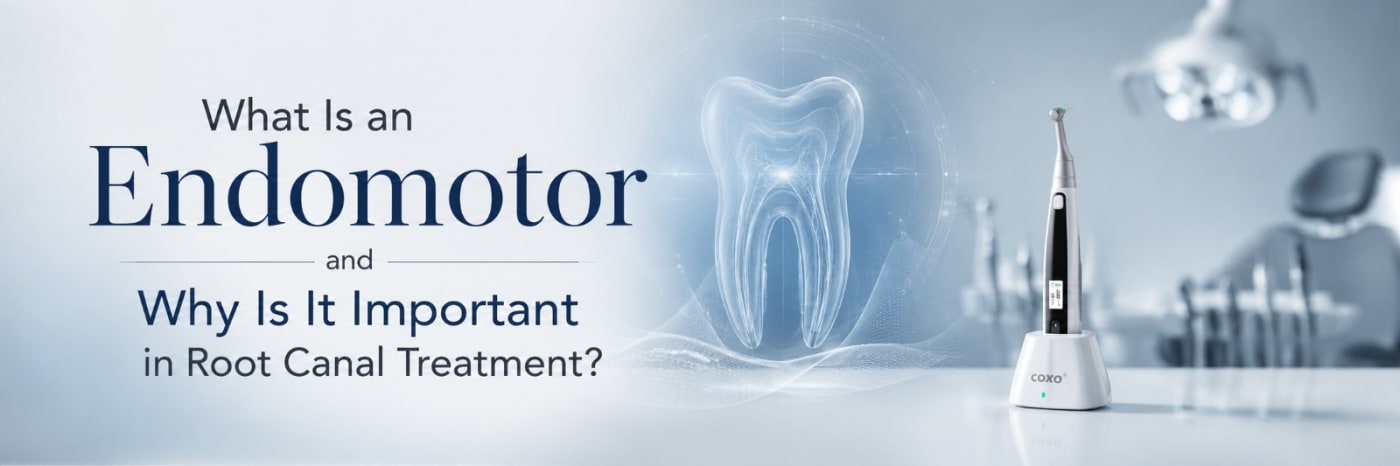
An endomotor is a dental device used to operate rotary or reciprocating endodontic files during root canal treatment. Instead of relying only on manual hand files, dentists use an endomotor to shape and prepare the root canal in a more controlled manner.
The main function of an endomotor is to provide controlled movement of the file inside the canal. This helps the dentist maintain better speed, torque, and motion according to the file system and clinical situation.
To put it simply, an endomotor increases the systematicity, efficiency, and predictability of root canal preparation.
Why Is an Endomotor Important in Root Canal Treatment?
Precision is necessary for root canal therapy. Each canal is unique. Certain canals are twisted, some are tiny, and some could be challenging to reach. Uncontrolled instrumentation may raise the possibility of procedural errors in certain situations.
An endomotor helps dentists by offering:
- Controlled file movement
- Better speed management
- Torque control
- Efficient canal shaping
- Improved clinical workflow
- Reduced operator fatigue
This does not mean that an endomotor replaces the dentist’s skill. It simply supports the clinician with better control and consistency during treatment.

Manual Files vs Endomotor
Manual files are still important in endodontics, especially for canal negotiation and glide path preparation. However, endomotors offer clear advantages during canal shaping.
Manual Instrumentation | Endomotor-Assisted Instrumentation |
More time-consuming | Faster canal preparation |
Highly operator-dependent | More controlled workflow |
May cause hand fatigue | Better ergonomics |
Limited control over file movement | Adjustable speed and torque |
Useful for initial canal exploration | Useful for efficient canal shaping |
A good endodontic workflow often combines both manual files and motor-assisted instrumentation.
Why Torque Control Matters
Torque control is one of the most important features of an endomotor.
During root canal preparation, the file rotates inside a narrow canal space. If the file faces too much resistance, stress can build up. This may increase the risk of file deformation or separation.
A motor with adjustable torque allows dentists to set the required force according to the file system and case complexity. This is especially useful in curved canals, narrow canals, and difficult endodontic cases.
Torque control helps make root canal preparation safer, smoother, and more predictable.
Why Speed Control Is Important
Different rotary file systems require different speed settings. Using the correct speed helps improve cutting efficiency and file control.
A good endomotor allows dentists to select the speed based on the file system and clinical need. This improves workflow and helps maintain consistency during canal preparation.
Speed control is particularly useful for dentists who perform root canal treatments regularly and want a more standardized endodontic workflow.
Endomotor with Apex Locator: A Practical Advantage
Working length determination is one of the most important steps in root canal treatment. If the working length is incorrect, cleaning and shaping may be compromised.
An endomotor with integrated apex locator helps dentists monitor the file position during canal preparation. This can reduce dependency on separate devices and make the workflow more convenient.
However, it should always be used along with proper diagnosis, radiographic evaluation, and clinical judgment.
For clinics looking to upgrade their endodontic setup, an endomotor with apex locator can be a practical and useful choice.
Reciprocating Motion in Endodontics
Many modern endomotors offer both rotary and reciprocating motion.
In rotary motion, the file moves continuously in one direction. In reciprocating motion, the file moves in a back-and-forth pattern. This can help reduce file stress in selected clinical situations.
Reciprocating motion can be useful in narrow canals, curved canals, or cases where controlled file movement is required. It gives dentists more flexibility depending on the file system and treatment protocol.
Key Features to Look for Before Buying an Endomotor
Before choosing an endomotor for a dental clinic, dentists should look beyond just the price. The device should match their clinical workflow and daily endodontic needs.
Important features to check include:
- Adjustable torque
- Wide speed range
- Rotary and reciprocating motion
- Integrated apex locator
- Brushless motor
- Compact head design
- Wireless operation
- Good battery backup
- Autoclavable contra-angle
- Reliable after-sales support
A good endomotor should be easy to use, comfortable to handle, and suitable for daily clinical practice.
A Practical Option for Modern Endodontic Workflow
For dentists planning to upgrade their endodontic workflow, a compact and multifunctional endomotor can make daily root canal procedures more efficient and controlled.
The Coxo EndoNova X Endomotor is one such option. It is a wireless endomotor with an integrated apex locator, brushless motor, adjustable torque, and a speed range of 100–2500 rpm. It also supports reciprocating motion and multiple working modes such as endo motor, ledge removal, endo activation, and polishing.
Its compact mini head and 360° rotatable design can help improve access, especially during posterior root canal procedures.
For clinics looking for a modern root canal setup, Coxo EndoNova X can be explored as a reliable addition to their endodontic workflow.

Conclusion
Endomotors have become an important part of modern endodontics. They help dentists perform root canal treatment with better control, efficiency, and consistency.
However, successful treatment still depends on proper diagnosis, case selection, irrigation, file system, working length control, and clinical expertise.
An endomotor is not a replacement for the dentist’s skill. It is a support system that helps make root canal workflow more predictable and efficient.
Related Products
 Asiga Max 3D Printer
 Asiga Max 2 Printer
 Asiga The Ultra 3D Printer
 Shining 3D AccuFab-L4K 3D Printer
 Phrozen Mighty 4K 3D Printer
 Elegoo Saturn 3 3D Printer
 GLB 200M Metal 3D Printer
 GLB 120M Metal 3D Printer
Disclaimer
This article is for general information. Product specifications and features change with the manufacturer — confirm details with our team before you buy. Full disclaimer